An accessory dwelling unit in Newton can be a new detached unit in the backyard, a converted garage, or a finished basement or attic. Each path is a self-contained home with its own kitchen, bath, and entrance, and the right approach depends on your lot, the existing structure, and how the utilities run.
Newton's larger lots, especially in Waban, Oak Hill, and Chestnut Hill, often have room for a compact detached ADU, while village homes may favor a garage or basement conversion. The work centers on framing, egress, fire separation, and connecting heat, water, and power correctly, with zoning reviewed by ISD.
A Newton ADU requires building permits under 780 CMR, with electrical, plumbing, and gas permitted separately by licensed trades.
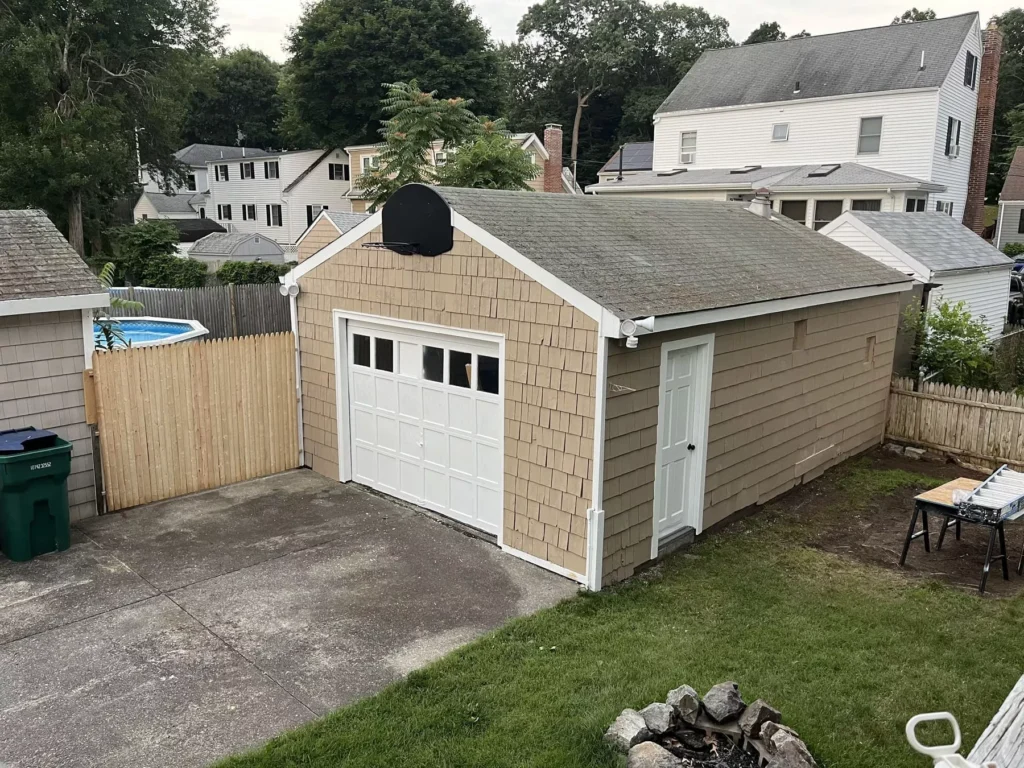
A typical JRH ADU project in Newton includes:
A detached backyard cottage, or a conversion of an existing garage, basement, or attic.
A complete kitchen and full bath with their own metered utilities.
Code-compliant egress, one-hour fire separation, insulation, and heat pumps.
Layouts drawn to Newton's zoning and the 900-square-foot by-right cap.
It suits owners who want long-term rental income, multigenerational living, or a guest suite carved from underused space.
We open with a free site visit to your Newton property, reviewing the lot, the existing garage or basement, and where water, power, and heat would tie in, then deliver an itemized estimate covering design, permitting, and zoning.
Once you sign off, JRH pulls the building permit through Newton's Inspectional Services Department, clears the zoning review, and coordinates licensed electricians, plumbers, and gas fitters on their own permits, confirming the unit stays inside the 900-square-foot by-right envelope.
Construction then moves through framing, egress and fire separation, systems, and finishes with inspections at each stage, ending in a final walkthrough and sign-off. A conversion of existing space generally finishes sooner than a new detached build.
Yes. Newton's Inspectional Services Department (ISD) requires a building permit for an accessory dwelling unit under the Massachusetts State Building Code (780 CMR), which covers construction, alteration, additions, and change of occupancy. Ordinary repairs and finish work like painting are the narrow exceptions.
Electrical, plumbing, and gas are permitted separately, and each must be pulled by a licensed trade rather than by the homeowner. Newton's ISD also reviews zoning, which matters on the city's larger lots and in its historic districts.
JRH files through Newton's Inspectional Services Department online permitting system and carries the project through every required inspection, so the work stays code-compliant and protects the home at resale. Newton ISD is located at 1000 Commonwealth Avenue and can be reached at (617) 796-1060 or [email protected].
The most common way a Newton project goes wrong is skipping permits: unpermitted work tends to surface during a future sale or refinance and costs far more to correct than to do right the first time.
In Massachusetts, ADUs generally run from about $150,000 to $450,000 or more, with detached new builds around $225,000 to $450,000, garage conversions near $150,000 to $200,000, and basement or attic conversions about $175,000 to $250,000 (D&G Exteriors, MA, 2025). In Newton, larger detached units on generous lots often sit toward the upper end.
Statewide rules changed in 2025: under the Affordable Homes Act, an ADU of up to 900 square feet is now allowed by-right in single-family zones across Massachusetts. Mass Save can also offset efficient heating, water heating, and insulation in the new unit.
Because JRH is a registered contractor, your Newton project is also covered by the state's Home Improvement Contractor program and Guaranty Fund. We give a free, itemized in-home estimate, with no starting-at guesswork.
JRH handles ADU projects throughout Newton and its thirteen villages, including Newton Centre, Newtonville, West Newton, Auburndale, Waban, Newton Highlands, Chestnut Hill, and Nonantum.
Newton, the Garden City, sits in Middlesex County across ZIP codes 02458 through 02468, with Green Line D service through Newton Highlands and Waban and commuter rail at Auburndale, West Newton, and Newtonville. Its housing leans toward larger single-family Colonials, Victorians, Tudors, and Capes, with grand estates in Chestnut Hill and Waban and more two-families and condos around Newton Corner and Nonantum.
JRH Constructions is a licensed Massachusetts home improvement contractor (MA HIC #204867), registered and active, so your Newton project is covered by the state's HIC consumer-protection framework. We are fully insured, and every permit is pulled and inspected through the City of Newton.
Based in Lynn and working across Newton's Colonials, Victorians, and village neighborhoods, JRH pairs local knowledge with code-compliant ADU construction. Call (781) 520-1982 for a free in-home estimate.
Because JRH is a registered Massachusetts Home Improvement Contractor (#204867), your Newton ADU project is covered by the state's HIC consumer-protection framework, and every stage is permitted and inspected through the City of Newton rather than done off the books.